
Surprising fact: many users assume “private cryptocurrency” simply means a different token — but privacy is primarily a design of tools, not just choice of coin. A Monero wallet that treats privacy as a systemic property (device, network, keys, and UX) closes the gap between cryptographic guarantees on paper and real-world anonymity. This matters in the US where legal, technical, and surveillance pressures make operational security as important as protocol design.
To see how this plays out, I’ll use Cake Wallet as a concrete case study. It supports Monero (XMR) and Haven (XHV) among many others, and bundles multiple privacy layers: device-level encryption, Tor/I2P, node choice, key handling, and integration with privacy tools for Bitcoin and Litecoin. The point isn’t to promote a brand but to show what a privacy-focused, multi-currency wallet must solve, what trade-offs it makes, and where it still breaks down.
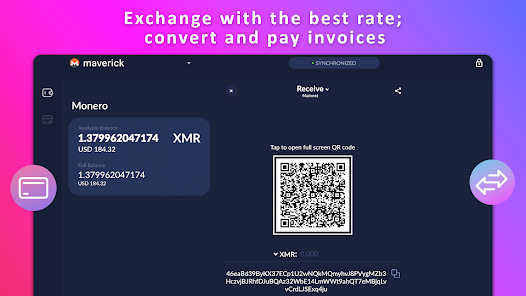
How a privacy-first XMR wallet actually works (mechanisms, not slogans)
Start with keys. A non-custodial wallet means the private keys never leave your device; Cake Wallet keeps the Monero private view key on-device. That’s crucial because Monero splits responsibilities: the spend key authorizes funds, the view key allows scanning the blockchain for transactions. If a wallet leaks the view key, someone could learn transaction metadata. By keeping the view key locally, and combining it with device-level encryption (Secure Enclave on iOS or TPM on Android), the wallet reduces the chance of key exfiltration even if the app environment is compromised.
Network privacy is the next mechanism. Transaction confidentiality is weak if your IP address is logged by a node. Cake Wallet offers Tor-only mode, I2P proxy support, and the ability to connect to custom nodes. Those layers are not redundant: Tor masks IP hops for node queries, I2P provides an alternative routing substrate, and custom nodes let advanced users run their own full node for maximum isolation. Together they convert Monero’s on-chain privacy into usable anonymity in the wild.
Operational features—subaddresses and background synchronization—are practical mechanisms. Subaddresses let you create unique receiving addresses for each counterparty, preventing easy linkage between payments. Background sync matters because users who only open a wallet intermittently can create timing correlations; continuous sync blunts timing analysis that an observer could exploit.
Comparing alternatives: Monero + Cake Wallet vs. other choices
No single option is optimal for every threat model. Here are trade-offs across three common approaches:
- Run a Monero full node + use a light wallet: Maximum protocol-level privacy, but higher setup and maintenance burden. If you value absolute control and can host a node (or run it in a VPS you control), this is the gold standard.
- Use a privacy-oriented light wallet (example: the wallet in this article): Lower friction, built-in network privacy (Tor/I2P), hardware-wallet support, and practical UX choices like innate subaddresses and background sync. You accept some reliance on remote node architecture unless you run a custom node.
- Rely on exchanges or custodial services: Easiest, poorest privacy. Exchanges centralize KYC and network metadata, undermining Monero’s privacy benefits.
Cake Wallet sits in the middle: it’s non-custodial and open-source, provides hardware wallet integration (Ledger, and an air-gapped “Cupcake”), and supports network privacy features. If you want lower friction for cross-chain convenience—built-in swaps with NEAR Intents automating routing—this wallet is practical. If you want the last 10% of metadata protection, run your own Monero node and connect the wallet to it.
Special cases: Haven protocol, MWEB Litecoin, and Zcash interactions
Haven (XHV) is interesting because it markets stable asset-like functionality built on Monero-derived privacy semantics. A multi-currency wallet that supports Haven lets users move funds between privacy-native variants, but beware: cross-chain swaps introduce linkage unless done through privacy-preserving routing and without reuse of addresses. Cake Wallet’s decentralized swap tooling (NEAR Intents) is designed to find competitive routes without central custody, yet any swap sequence can create analytic links if you reuse addresses or leak network metadata during the process.
For Litecoin, Cake Wallet supports MWEB, an optional privacy layer. MWEB’s privacy model differs from Monero: it’s an extension with aggregated transaction kernels, so the privacy guarantees depend on adoption and how the wallet constructs transactions. The practical upshot is that optional privacy can be powerful but also fragile if counterparties or plumbing don’t adopt it consistently.
Zcash handling is stricter: Cake Wallet enforces mandatory shielding when sending ZEC, preventing accidental transparent outputs. That’s a useful UX guardrail because ZEC’s transparent addresses can leak recipient or sender linkage if used carelessly.
Security trade-offs and real limitations
Nothing is absolute. A wallet that encrypts keys with device hardware (Secure Enclave or TPM) dramatically raises the bar for remote theft, but a physically compromised device or malware that captures keystrokes before authentication still poses risk. Biometric or short PIN access (4–6 digits) balances convenience against brute-force risk; some users should prefer a longer passphrase.
Network-level defenses (Tor/I2P/custom nodes) reduce IP exposure but introduce other trade-offs: Tor exit nodes can be blocked by some services; Tor increases latency and can complicate the timely broadcasting of transactions. I2P has fewer exit nodes and smaller user bases, which can both aid anonymity and reduce resilience. Running your own node avoids these intermediary trade-offs, at cost of complexity.
Built-in exchange and swap features are convenient but expand the wallet’s attack surface: third-party market makers, liquidity providers, and routing systems can introduce counterparty risks or metadata leakage if implemented poorly. Cake Wallet’s NEAR Intents approach reduces dependence on a single market maker, but decentralized routing still relies on liquidity path privacy; monitor how swaps are constructed and whether the wallet offers “privacy-preserving” routing flags.
Decision framework: choosing a wallet for Monero and multichain privacy
Here’s a simple heuristic to map threat model to choice:
- If your key concern is maximal protocol isolation and you can host infrastructure: run a Monero full node and use a wallet that connects to your node.
- If you want strong privacy with easy multisig/hardware-wallet support and cross-chain swaps: choose a non-custodial, open-source wallet with Tor/I2P, robust key handling, and hardware integration (like Ledger support and air-gapped Cupcake option).
- If you trade often across chains but need privacy: prefer wallets that offer decentralized routing and do not centralize swap custody; avoid reusing addresses and use subaddresses aggressively.
In practice in the US, legal and service friction matters: exchanges implement KYC and can be subpoenaed. For privacy-aware users, minimizing custodial exposure while using strong device and network protections is usually the rational middle path.
What to watch next (near-term signals and conditional scenarios)
Watch these items because they change practical privacy outcomes: node adoption rates (for MWEB, for Monero relay policies), wallet implementations of swap routing (how much metadata is exposed to market makers), and OS-level security changes (e.g., changes to Secure Enclave/TPM APIs that restrict third-party apps’ use). If a large fraction of users adopt MWEB or a similar layer, privacy improves, but partial adoption can produce edge cases where traceability remains high. Conversely, any tightening of app platform policies that restrict Tor or background networking could materially degrade light wallets’ anonymity unless they adapt.
If you want to explore a practical multi-currency privacy wallet that bundles many of these protections into a usable package, see https://cake-wallet-web.at/ for platform availability and supported features.
FAQ
Do I need a hardware wallet to be private with Monero?
No — Monero’s privacy is encoded in the protocol, not the key storage. But hardware wallets (Ledger, Cupcake air-gapped) reduce the chance your spend key is stolen. If you hold significant funds or are at high risk, a hardware wallet is a sensible layer to add.
Can swaps between XMR and BTC be truly private?
Swaps can be designed to limit linkage, especially via decentralized routing and careful address management. However, every cross-chain operation introduces potential metadata leakage. Using decentralized routing, fresh addresses, and network privacy reduces risk but does not eliminate all correlation capabilities for a well-resourced observer.
Is running my own node worth it?
Yes if your goal is the highest confidence in privacy and you can manage the technical burden. A personal node removes dependence on remote node operators (who can log IPs or introduce timing leaks). For many US users, a hybrid approach (run a node on a VPS you control or use a privacy-preserving light wallet with Tor) is a pragmatic compromise.